Remarks by Beatriz Sznaider on The Empty Chair by Claudia Yelin
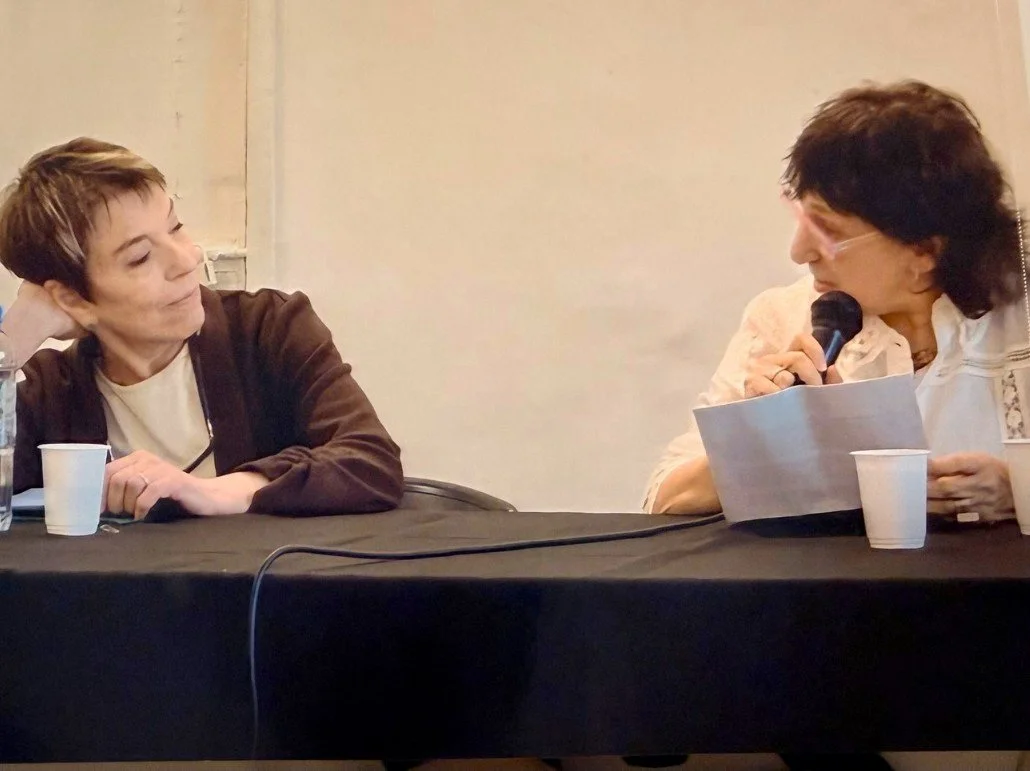
This presentation was given by Beatriz Sznaider on March 22, 2026, on the occasion of the presentation of The Empty Chair. Her reading situates the book within its historical context and offers a perspective deeply connected to memory, justice, and transmission.
Thank you for joining us in this very special place and at such a significant moment for the country, and thank you to Claudia Yelin for allowing me to take part in the presentation of her book The Empty Chair. For me, this is a deeply moving moment.
Writing a book is always an act of courage. And in the case of those that address the subject of our disappeared, it also means standing at the edge of an emotional abyss. Writing then becomes an attempt to eclipse one’s own despair and that which was imposed upon society as a whole through terror—effects that, in many cases, continue to this day.
The starting point that inspires the novel The Empty Chair is the kidnapping and disappearance of Hugo Malozowski, Claudia’s brother-in-law; Jorge Pérez Brancatto; Jorge Sznaider, my brother—all three 19 years old—and of Noemí Beitone, Mirta Silber, and Carlos Pérez, the latter a young married couple. It happened on May 12, 1979, in the city of Buenos Aires, during a joint operation carried out by the Federal Police, the Buenos Aires Provincial Police, and the Argentine Army.
They were taken from the apartment shared by Hugo and Jorge Pérez Brancatto, where they had gathered to spend a Saturday night together as friends. Hugo and the two Jorges also attended the same school—the first year of teacher training at the Mariano Acosta—and, together with Mirta and Carlos, were part of the Horacio Quiroga Literary Workshop. All of them were brilliant, unique, with strong and creative personalities. They were politically engaged, yes. They opposed dictatorship, as we all do here. They gave their lives for that, but I know they did not choose their deaths.
In The Empty Chair, Claudia bears witness. She does so through an autobiographical fiction that weaves together the everyday life and emotional experience of a family in exile—her family. The different, necessarily subjective points of view allow us to approach pain, uncertainty, but also resilience and solidarity among its members.
Alongside the value of testimony, this book is driven by the purpose of transmission. It is addressed especially to younger generations, to bring them closer to a reality that is difficult to convey: we are speaking of acts that place us at the limits of the human—or perhaps at the limits of the inhuman.
Testimony and transmission. I believe the book embodies the premises proposed by psychologist and educator Jerome Bruner in Making Stories, when reflecting on the nature and uses of narrative:
Narrating is an interpretive act that turns a story into a version of a human life or a cultural community.
Narrating shapes the mind and social experience.
Narrating allows us to imagine possible worlds and life projects.
Narrating is a privileged way of constructing identity.
Narrating is a way of grasping and making sense of reality.
Narrating is a radically intersubjective activity.
And above all: narrating is a dangerous activity.
Is that why Hugo, Jorge, Mirta, and Carlos were murdered? Because narrating was dangerous?
The Empty Chair, awarded in its English version, now represents in Spanish another link in the long chain of actions through which a large part of society has tried—and continues to try—to ensure that extreme violence is not used as a mechanism of social control or as a way of managing political conflict, and that instead rationality and compassion prevail.
In that chain is also inscribed the struggle for our disappeared and for all the victims of state terrorism. In this regard, I would like to briefly mention the trial held in June 2012 at Federal Oral Court No. 1 of San Martín. There, some of those responsible for these disappearances were tried: two retired commissioners of the Buenos Aires Provincial Police, Roberto Bustos and Jorge Bianchero, sentenced to 19 and 9 years in prison.
The judges unanimously ruled that the acts constituted crimes against humanity and were therefore not subject to any statute of limitations.
The ruling was received with applause by the families. Then, each of the disappeared was named, followed by the cry: “present.”
In the courtroom was León Sznaider, my father, who, together with attorney Pablo Llonto, had promoted the case from the very beginning. The audience applauded him, recognizing his tireless struggle.
Why was there a trial?
Because the families never sought revenge. We chose the institutional path in the face of those who violated every principle of the republic and of human rights.
Because there were organizations, activists, and lawyers committed to reconstructing a history that had been deliberately hidden.
And because my parents, Paulina Grosser and León Sznaider, wanted it and fought for it.
I did not believe it was possible to reach that point. Nor was I sure it was necessary. I thought the true achievement was for society to understand that the coup d’état had not sought to end violence, but to fracture society at every level.
The abyss between those who upheld life with dignity and those who exercised extreme violence is immense—like the distance between a flower and a missile.
Will the flower survive? I do not know. But in that trial something took root: an institutional act that recognized rights and limits. There was, at least in part, a form of reparation.
After the trial, my parents experienced a kind of afterlife. They felt they had done everything possible.
As Marcos “Maco” Somigliana of the Argentine Forensic Anthropology Team said: they are not disappeared—they are people for whom we continue to fight so that they may recover their identity. And he also said: it is not a luxury for a society to have basic parameters of humanity. That is what human rights are. Everything else is barbarism.
There is a deep and sensitive connection between the writing of our young people and Claudia’s writing. Let us listen to her. Let us feel that Hugo, Jorge, and all the victims speak through her words.